

When it comes to foundations, the genuine choice is usually between three systems: traditional concrete, mini piles and screw piles. Each has conditions under which it is the correct specification, and conditions under which it is not.
The three systems defined
Concrete strip or trench fill. A trench is excavated, concrete is placed, and the structure is built off it. Well understood, economical on competent shallow ground, and within the competence of any general builder.
Mini piles. Small-diameter piles, augered or driven, that transfer load to deep competent strata and carry high loads. Specified where suitable bearing ground lies well below the surface.
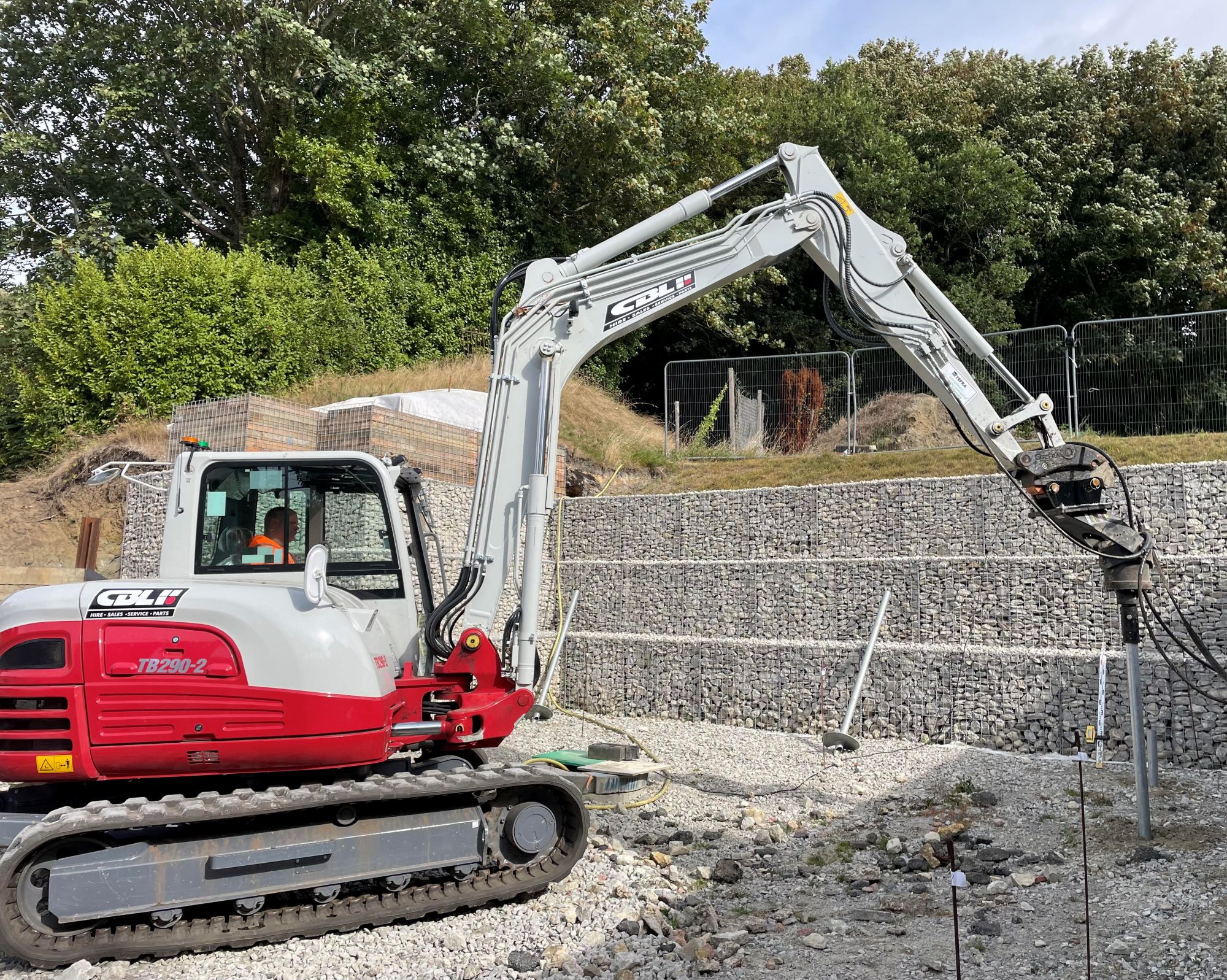
Screw piles. Helical steel piles installed with a low-vibration rig, bearing on competent strata and capable of being loaded almost immediately. Rapid to install, low-spoil, and removable.
Whichever system suits your site, the foundation must satisfy Approved Document A, which covers structural loading and ground movement, and any piled design should follow Federation of Piling Specialists guidance on design to Eurocode 7.
Comparison of key criteria
| Criterion | Concrete strip/trench | Mini piles | Screw piles |
|---|---|---|---|
| Typical use | Shallow foundations on good ground | Deep strata, high loads | Extensions, new builds, restricted sites |
| Programme | Slow: excavate, pour, cure | Moderate | Fast: often installed in hours |
| Access and headroom | Needs open excavation | Compact rigs available | Compact rigs available |
| Load capacity | Fine for typical low-rise | Very high | High, with a practical ceiling |
| Ground suitability | Poor on soft, deep or made ground | Good, including deep strata | Good, including made ground and near trees |
| Spoil and disposal | Excavated soil to remove | Auger arisings, costly if contaminated | Minimal |
| Vibration and noise | Low | Higher if driven | Low |
| Reversibility | Permanent | Permanent | Removable |
| Verification | Visual inspection | Set or load testing | Torque logged at install |
Cost drivers beyond the unit rate
The unit rate is the figure most often quoted and will usually favour concrete as the most cost effective method, however this rarely determines the true cost of the works. Three cost drivers sit outside that rate and materially affect the total.
Programme. Concrete occupies the site through excavation, placement and curing, frequently a week or more before construction can proceed above it. Screw piles are often installed and loaded within a day. On a constrained programme, the days saved translate directly into reduced labour and preliminaries.
Spoil and reinstatement. Both excavation and augering generate arisings requiring removal. On contaminated or made ground, that material is charged for disposal by the tonne as controlled waste. Screw piles displace rather than excavate, minimising both removal and subsequent reinstatement.
Access and plant. A restricted or awkward site can preclude the plant a given method requires, or necessitate a smaller, slower rig. The cost of mobilising and demobilising plant should be accounted for, not only the operating rate.
The valid comparison is between finished, cleared, load-ready foundations, not between raw material rates. That is where the difference between the three systems becomes apparent.
Where concrete is appropriate
For a straightforward single-storey extension on competent shallow ground, with open access and no programme constraint, concrete is difficult to better on cost. It is well proven, requires no specialist plant, and is familiar to every builder. Its limitations emerge where the ground is soft, deep, made or affected by vegetation, or where the excavation and curing period cannot be accommodated. See our screw piling vs concrete foundation cost comparison post for more information.
Where mini piles are appropriate
Where the competent stratum is deep, loads are very high, or the capacity of a bored or driven pile is required, mini piles are the appropriate specification. The principal trade-off is spoil.
Augered mini piles bring arisings to the surface, and on contaminated or made ground that material carries a real disposal cost. Driven variants introduce vibration, a material consideration adjacent to sensitive or shared structures.
Where screw piles are appropriate
Screw piles are best suited to restricted, awkward and vibration-sensitive sites. They install within hours rather than days, with minimal spoil, low vibration and no curing period, allowing near-immediate loading. They perform in made ground and in clay adjacent to vegetation including in root protection zones. Because they are wound in rather than cast, they can be extracted and the ground reinstated at end of life. Installation torque is logged throughout, providing a continuous indication of capacity.
They are not without limits. For exceptionally high loads, or where bedrock lies close to the surface with insufficient soil to provide lateral support, an alternative system may be preferable. We would rather state that plainly than oversell the system.
Is a Screw Piling Foundation the Right Fit for your Project?
To summarise, here are five questions that means screw piling could be the best fit for your prkect
- How deep is competent ground? Depth favours piling over concrete.
- What is the loading? Very high loads favour mini piles.
- What is the access? Restricted access favours screw or mini piles on compact rigs.
- Is the ground made or contaminated? Spoil and disposal favour screw piles.
- Are vibration or programme critical? Both favour screw piles.
For a screw pile foundation specification suited to your site, contact Preformed Substructures . We will assess your ground, loading and access, and advise honestly which of the three systems is appropriate, including where it is not ours.
continue reading