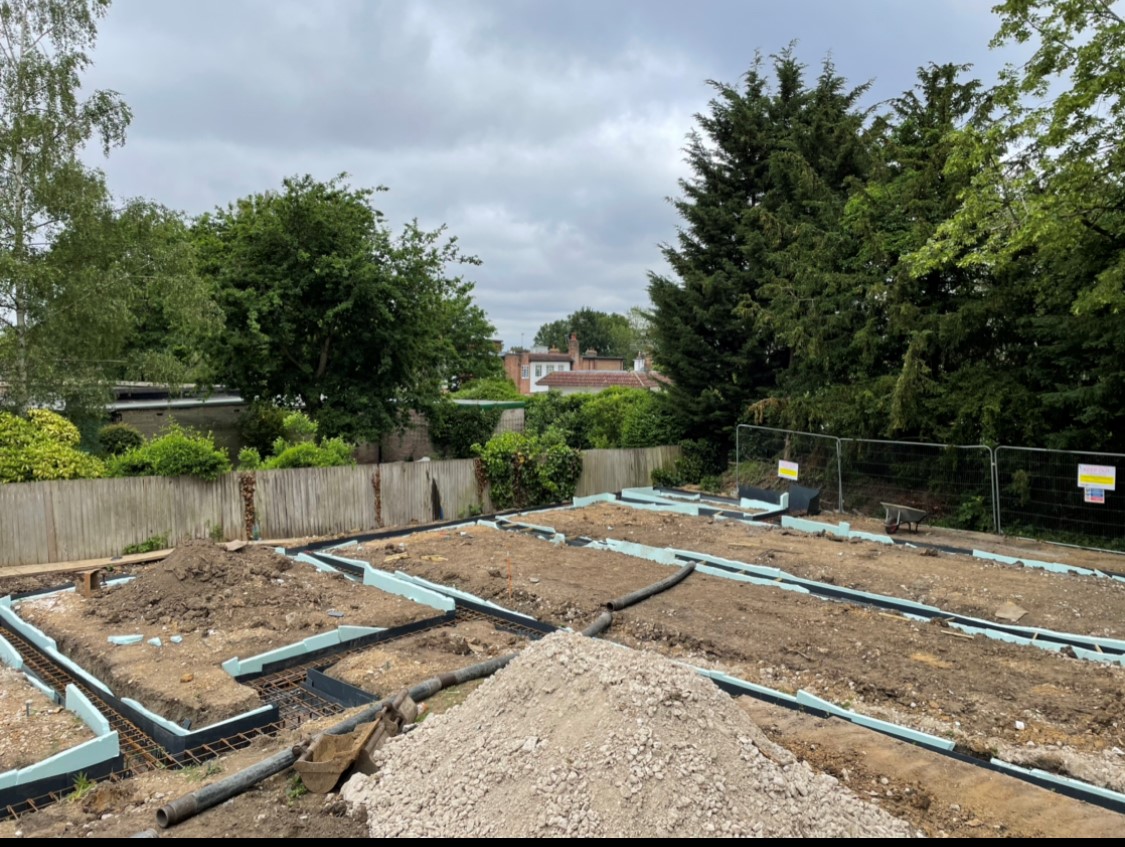

The trial pit looked promising for the first half metre, then the bucket came up full of brick, clinker and the remains of a Victorian floor slab. By two metres there was still no natural ground, the spoil heap had become a waste classification problem, and the strip foundation priced at tender was no longer realistic.
Most contractors on infill and brownfield sites will recognise that morning. This guide covers what made ground is, why it undermines shallow foundations, how the options compare, and why screw pile foundations are often the most practical way through it.
What Is Made Ground?
Made ground is material deposited by human activity rather than natural geological processes, as the BRE’s guidance on building on fill defines it. It is usually placed in layers at different times with different compaction, so a borehole at one corner of a plot can find well-compacted hardcore while a trial pit ten metres away hits soft backfill over a buried cellar.
| Made ground type | Main engineering risk | Effect on screw pile installation | What to check in the GI |
| Demolition rubble and brick fill | Voids, uneven density, buried obstructions | Helix may refuse on brick or concrete; usually penetrable once cleared or pre-augered | Obstruction depth and extent |
| Ash, clinker and slag | Chemical attack on steel and concrete | Penetrable, but corrosion allowance becomes a design issue | Sulphate, pH and chloride testing |
| Clay or soil backfill | Ongoing consolidation, downdrag on piles | Easy to install through; the fill adds load to the pile rather than carrying it | Undrained shear strength, age of fill |
| Domestic or mixed waste | Settlement as organics decompose, landfill gas | Penetrable but unpredictable; gas and contamination controls needed | Gas monitoring, organic content |
| Relic foundations and slabs | Hard spots beside soft spots | Piles relocated around them or cored through | Historical mapping, trial pits at pile positions |
Why Strip and Raft Foundations Struggle
The strip foundation guidance in Approved Document A (Section 2E) only applies where there is no non-engineered fill or wide variation in ground conditions under the loaded area. Once made ground is present, the foundation needs engineering design, which usually means digging down to natural ground or choosing another system.
The reasons are mostly about movement: fill of mixed density settles unevenly, it keeps compressing under its own weight for years, organic material loses volume as it decomposes, and the NHBC Standards warn that rising groundwater can trigger sudden inundation settlement. A raft spreads the load but still moves with the fill, and Speedeck suggests trench fill usually becomes uneconomic once fill is deeper than about 1.5 to 2 metres.
The hidden cost: muck-away
Excavated made ground often can’t be disposed of as clean inert spoil. Take a 20-metre run of trench fill, 0.6 metres wide and 2.5 metres deep: that is around 30 m³, or roughly 54 tonnes at an assumed 1.8 t/m³. At HMRC’s landfill tax rates from April 2026, classification makes a large difference before haulage and gate fees are even added.
| Spoil classification | Landfill tax per tonne | Tax on 54 tonnes |
| Qualifying inert material (lower rate) | £8.65 | approx. £470 |
| Non-qualifying material (standard rate) | £130.75 | approx. £7,060 |
On a 20-metre extension footing, the classification of the spoil alone can swing landfill tax from under £500 to over £7,000.
Foundation Options on Made Ground Compared
The right choice depends on the depth and content of the fill, so treat this as general practice rather than a design recommendation.
| Option | Works best | Struggles on made ground | Spoil |
| Deepened strip or trench fill | Fill under roughly 1.5 to 2 m over good natural ground | Deep or variable fill, groundwater | High |
| Raft | Light structures on fairly uniform fill | Variable or decomposing fill | Moderate |
| Vibro stone columns | Granular fills within NHBC limits | Organic, very soft or landfill material; NHBC Chapter 4.5 also flags gas pathways | Low |
| Mini piles | Deep fill, heavier loads | Bored piles create contaminated arisings; driven piles bring vibration | Moderate to low |
| Screw piles with ground beams | Fill over competent strata within reach, light to medium loads, tight sites | Dense obstructions at pile positions | Very low |
Screw piles are strongest where the fill is the problem but the ground beneath it is reasonable; where every pile position meets concrete, or competent ground is very deep, other piling methods may suit better. Our comparison of screw piles, mini piles and concrete foundations and our guide to screw pile costs compared with concrete go into more detail.
How Screw Piles Get Through Made Ground
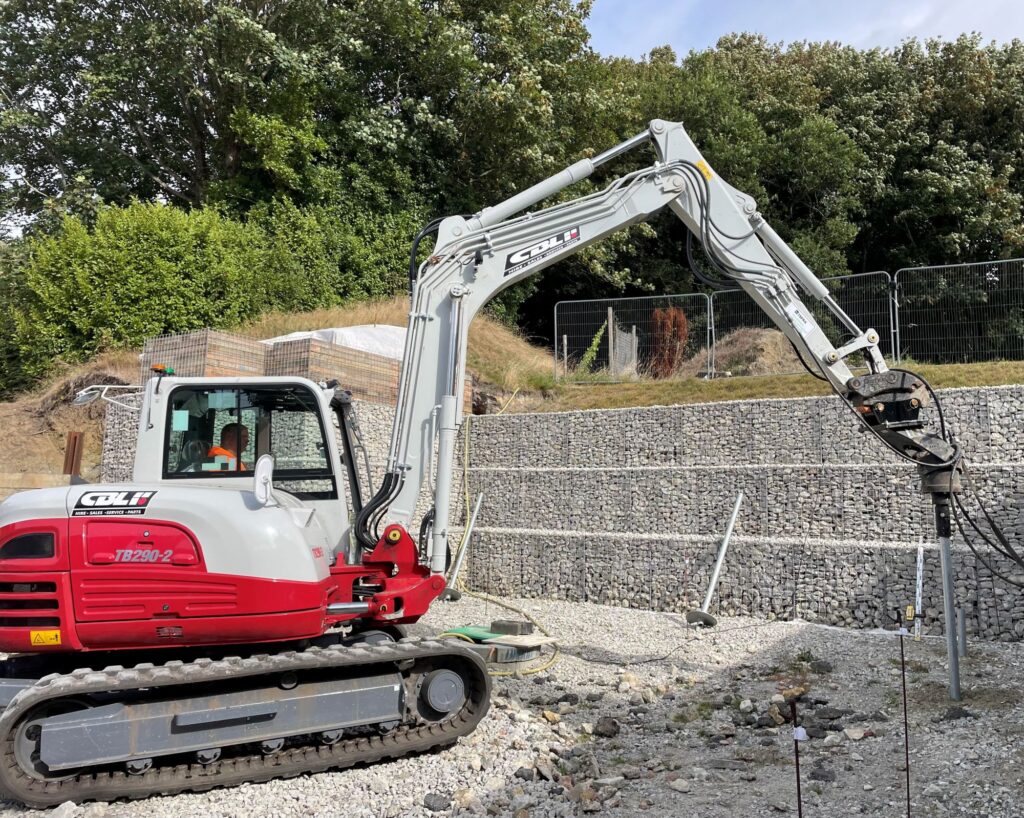
A screw pile is a steel shaft with helical plates near its toe, rotated into the ground hydraulically. On made ground the fill is treated as something to pass through rather than found on: the pile is advanced until the helices sit in the natural stratum beneath, which then carries the load. Our guide to soil bearing capacity explains how that layer is identified.
Installation torque rises as the helix enters stronger ground, so the installer gets a live check that each pile has reached competent material, although the torque-to-capacity relationship is empirical and should be confirmed by the designer. Extensions can be added on site if competent ground is deeper than expected, and because the pile displaces rather than excavates, there is very little spoil to classify.
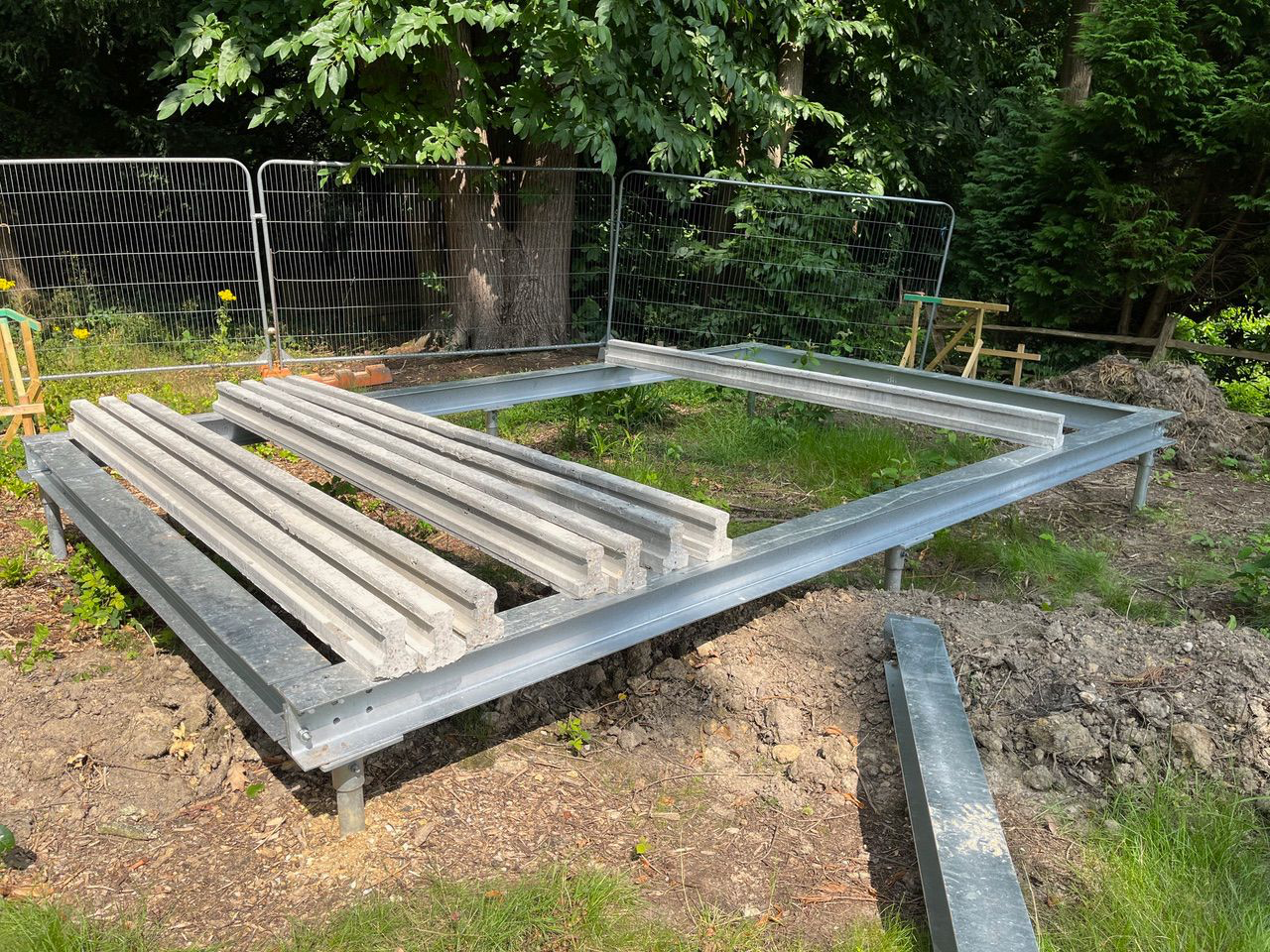
A ground beam system then spans between the piles, so the building bridges over the fill, and since there is no curing period the substructure can often be finished in days. That is why the approach suits house extensions and restricted access sites.
What the Ground Investigation Needs to Establish
The NHBC guidance for investigations requires work to BS EN 1997-2, with testing by UKAS or MCERTS accredited laboratories. For piling through fill, these are the questions that shape the design.
| Question | Why it matters | Typical method |
| How thick is the fill, and how much does it vary? | Sets pile length across the site | Window samples or boreholes at several positions |
| What is the competent stratum, and how deep? | The helices must bear in it | Boreholes with in-situ testing |
| Are there obstructions at pile positions? | Can stop or deflect a pile | Desk study, historical maps, trial pits |
| Is the fill still settling? | Settling fill drags piles down | Fill age and type, strength testing |
| How aggressive is the ground to steel? | Sets corrosion allowance and coating | pH, sulphate, chloride, resistivity |
| Is gas or contamination present? | Gas protection, safety, waste handling | Gas monitoring wells, chemical testing |
| Could groundwater rise? | Can trigger inundation settlement | Monitoring wells over several visits |
One borehole is rarely enough on fill. On a tight budget, a few window samples across the pile grid plus one borehole proving the competent stratum usually tell the designer more than a single deep hole in a corner.
How Pile Design Changes on Made Ground
Designers will normally ignore any support from the fill, which often means longer piles than on a greenfield plot. Where the fill is still consolidating, it grips the shaft and pulls it down, and Structville’s explanation of negative skin friction shows how that drag is added to the working load rather than counted as support.
The chemical test results drive the coating and any sacrificial steel thickness, and obstructions are best handled with a probing or pre-augering stage plus a ground beam layout that tolerates a pile moving slightly.
Where gas is present, the substructure needs gas protection and the installation shouldn’t open new pathways between layers. Torque records for every pile, checked against the design target, give a site-wide record of performance, with a preliminary load test on larger schemes.
Need Assistance Building on Made Ground?
The contractors who handle made ground well treat it as a known risk from the start: they investigate across the whole footprint and choose foundations that bypass the fill rather than rely on it. Screw piles won’t suit every brownfield plot, but where competent ground sits within reach they can cut spoil, shorten the programme and give a torque record for every pile.
Preformed Substructures installs screw pile foundations across South East England, including London, Kent and Surrey, and our recent projects show the approach in practice. If you’re pricing a scheme on made ground, send us the ground investigation and drawings and we’ll advise whether screw piles are suitable.